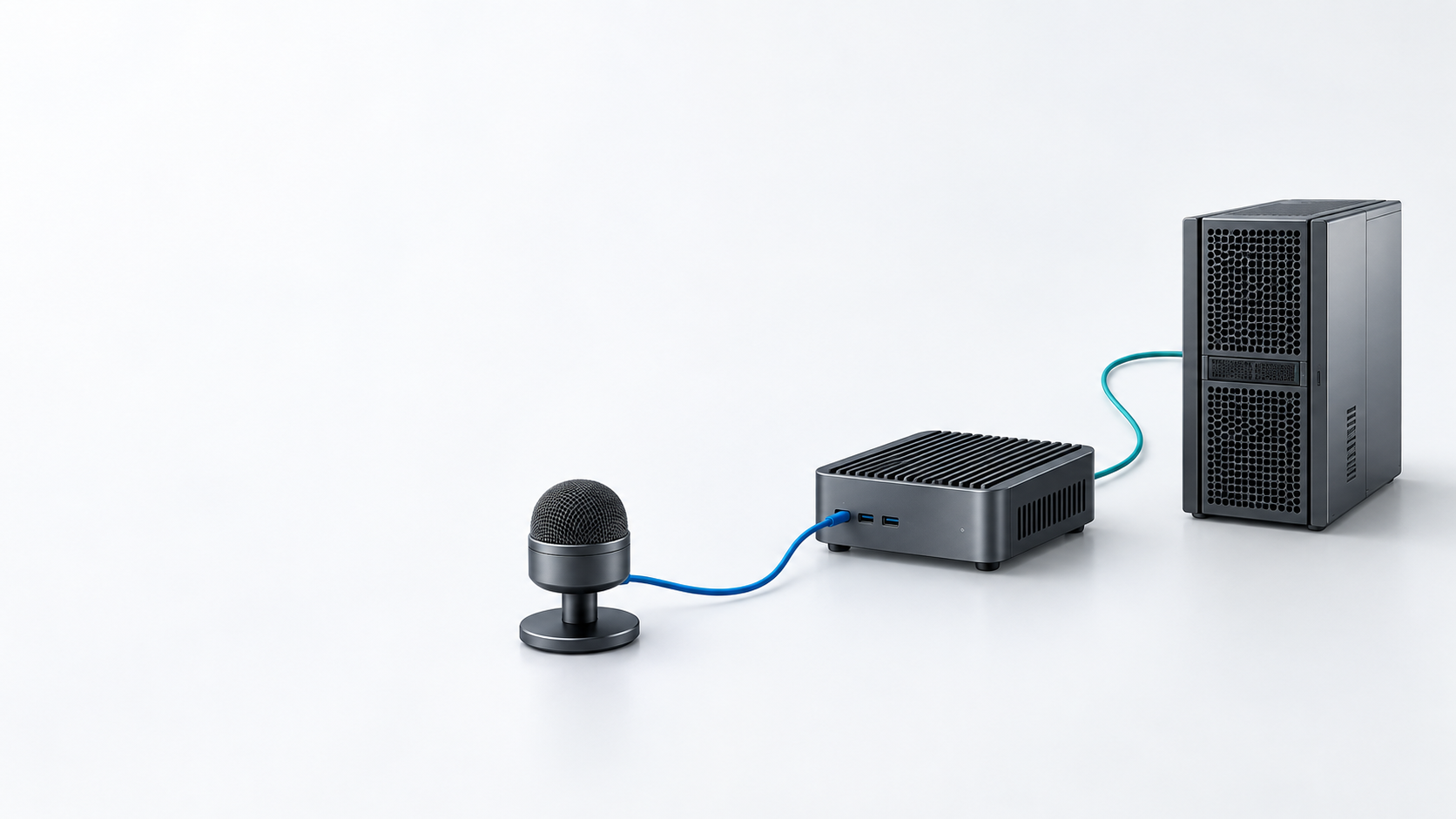
On-Device and Edge Authentication for Critical Voice Workflows
Voxmind provides MFA-compliant, SCADA-compatible on-device and edge voice authentication for critical infrastructure, operational technology and industrial environments.
The platform verifies speaker identity, human presence and voice authenticity close to the point of audio capture, supporting low-latency authentication, deepfake detection and continuous monitoring across manufacturing plants, SCADA-managed operations, HMI-enabled workflows and high-risk industrial environments.
Operational value for critical voice workflows
Voxmind provides voice authentication for OT environments where operator identity, command authorisation and session integrity are part of the control path.
The platform supports low-latency local verification, reduced remote processing dependency, stronger protection against synthetic voice attacks and controlled handling of voice authentication data. Continuous monitoring extends assurance beyond the first verification event, returning policy-ready identity, authenticity, replay and session risk signals for escalation, command authorisation and workflow interruption.
For critical infrastructure, manufacturing plants and SCADA-managed operations, Voxmind provides an MFA-compliant, SCADA-compatible authentication control for high-risk voice workflows where identity assurance, operational continuity and controlled data movement are security requirements.
Edge authentication for OT environments
Critical infrastructure and industrial operations require authentication controls that align with latency, uptime, network segmentation and local processing requirements.
Voxmind adds real-time voice authentication at the edge of the enterprise and OT architecture. The system verifies the enrolled speaker, assesses human presence, detects synthetic or replayed speech and returns policy-ready outputs for access, escalation, command authorisation or workflow interruption.
This positions voice-based identity assurance closer to operational control, including control rooms, field operations, HMI devices, embedded endpoints and SCADA-managed workflows.
SCADA-compatible authentication control
Voxmind operates as a SCADA-compatible voice authentication control for OT environments where operator identity, command authorisation and workflow escalation require stronger assurance.
The solution operates alongside established control systems, communications infrastructure, operator workflows and enterprise decision layers. Voxmind returns policy-ready risk and authentication outputs to support access, escalation, step-up verification or workflow interruption according to enterprise policy.
Technical capability
Voxmind combines advanced physics-based voice biometrics, human presence analysis, deepfake detection and session-level monitoring in an edge-ready architecture.
| Capability | Function |
|---|---|
| Speaker verification | Matches the live speaker against the enrolled voice identity. |
| Human presence analysis | Assesses live human speech characteristics. |
| Synthetic speech detection | Detects cloned speech, live voice conversion and generated audio. |
| Replay risk assessment | Identifies recorded playback and reused voice samples. |
| Continuous monitoring | Tracks identity confidence, authenticity and session risk after initial verification. |
| Policy-ready output | Returns identity, authenticity, replay, deepfake and session risk signals to the enterprise decision layer. |
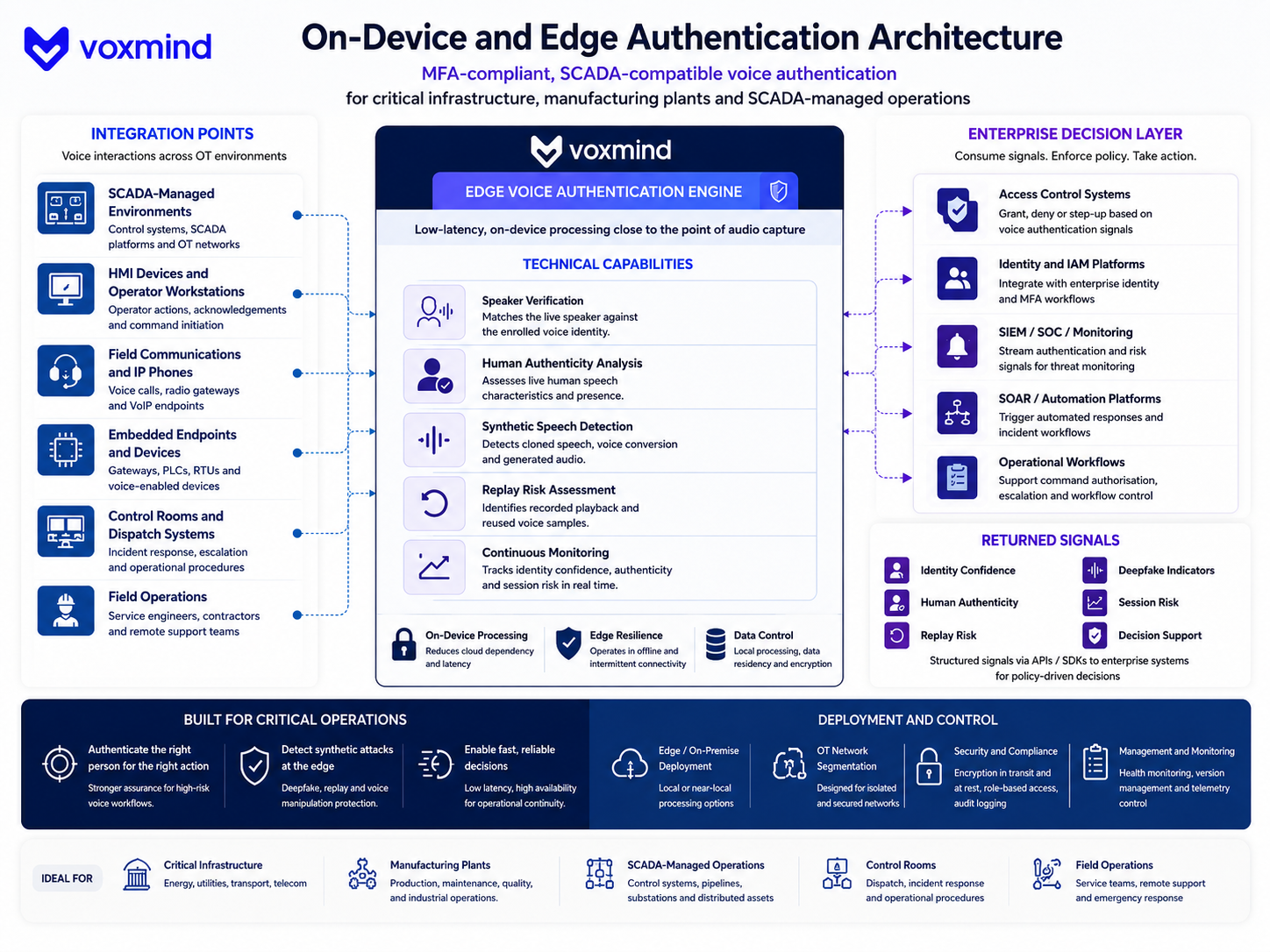 View full-size diagram
Deployment environments for on-device and edge authentication
Critical infrastructure
Voxmind supports voice authentication for energy, utilities, transport, telecom networks and other operational environments where voice-based authorisation intersects with resilience and security.
Manufacturing plants
Voxmind verifies operators, engineers, contractors and support personnel during maintenance workflows, production escalation, incident response and high-risk operational communications.
SCADA-managed operations
Voxmind adds SCADA-compatible voice authentication to environments where operator identity, command authorisation and workflow escalation require stronger assurance inside the existing OT architecture.
HMI devices and operator workstations
Voxmind supports voice authentication around HMI-based workflows where operator action, escalation, acknowledgement or command initiation requires identity assurance.
Industrial control rooms
Voxmind supports real-time verification for control room decisions, escalation paths, remote instructions and voice-enabled operational procedures.
Field operations
Voxmind supports authentication for distributed teams, service engineers, emergency response workflows and remote operational support.
Edge deepfake detection
Cloned speech, replayed audio, live voice conversion and synthetic voice injection are active attack methods against enterprise voice channels. In OT environments, those attacks create risk around operator identity, authorisation and command trust.
Voxmind brings deepfake detection into the edge authentication path, assessing whether the voice is real, live and authentic before sensitive workflows proceed. Continuous monitoring then tracks risk as the interaction develops, supporting detection of replay attacks, post-authentication call takeover and synthetic voice manipulation.
Data control and deployment resilience
Edge deployment gives enterprises tighter control over voice processing, authentication telemetry and data movement. Voxmind supports local or near-local processing models aligned with OT segmentation, data residency requirements and operational continuity objectives.
The platform supports controls for raw audio, voiceprints, authentication outputs, retention, deletion, encryption and deployment locality. This is relevant for regulated environments, critical operations and segmented OT networks where local processing, restricted data movement, auditability and controlled access to operational systems are core security requirements.
Integration model
Voxmind integrates with established OT architectures across SCADA-managed environments, HMI devices, control room systems, field communications, IP phones, embedded endpoints and voice-enabled industrial systems.
The edge deployment sits close to the audio capture point and provides a local authentication control for operational voice workflows. Voxmind verifies speaker identity, human presence and voice authenticity before returning structured authentication and risk signals to the enterprise decision layer.
Integration routes include APIs, embedded SDKs and edge deployment patterns that support local processing, enterprise decision routing and policy-based workflow control. The architecture supports deployment alongside SCADA platforms, operator workstations, control room procedures and segmented OT networks.
| Integration area | Technical role |
|---|---|
| Audio capture point | Supports authentication close to the source of the voice interaction. |
| Edge deployment | Enables local or near-local processing for latency-sensitive OT environments. |
| APIs | Return structured authentication and risk signals to enterprise systems. |
| Embedded SDKs | Support integration into devices, endpoints and voice-enabled industrial systems. |
| SCADA-managed workflows | Allow authentication signals to support command authorisation, escalation and operational review. |
| Enterprise decision layer | Consumes authentication and risk signals for access, step-up verification, workflow interruption or review. |
Voxmind adds MFA-compliant, SCADA-compatible voice authentication without requiring a rebuild of established SCADA workflows, HMI processes or enterprise decision logic.
Deploy edge voice authentication in your OT environment
Add MFA-compliant, SCADA-compatible voice authentication to critical infrastructure, manufacturing and SCADA-managed operations.
FAQs
Is Voxmind compatible with SCADA-managed operations?
Yes. Voxmind is SCADA-compatible and operates as a voice authentication control within the OT architecture.
Does Voxmind support HMI devices and operator workstations?
Yes. Voxmind supports voice authentication around HMI devices and operator workstations where identity assurance is required for acknowledgement, escalation, command initiation or sensitive operational workflows.
Does Voxmind require cloud processing?
Voxmind supports on-device and edge deployment models, reducing dependency on remote cloud processing for high-risk authentication events.
What operational environments does Voxmind support?
Voxmind supports critical infrastructure, manufacturing plants, utilities, transport networks, telecom operations, industrial control rooms, field operations, HMI-enabled workflows and embedded voice systems.
Does Voxmind provide edge deepfake detection?
Yes. Voxmind detects cloned speech, replayed audio, live voice conversion and synthetic voice injection as part of the edge authentication workflow.