Real-Time Deepfake Voice Detection for Enterprises
Protect payments, accounts and operational decisions from voice impersonation.
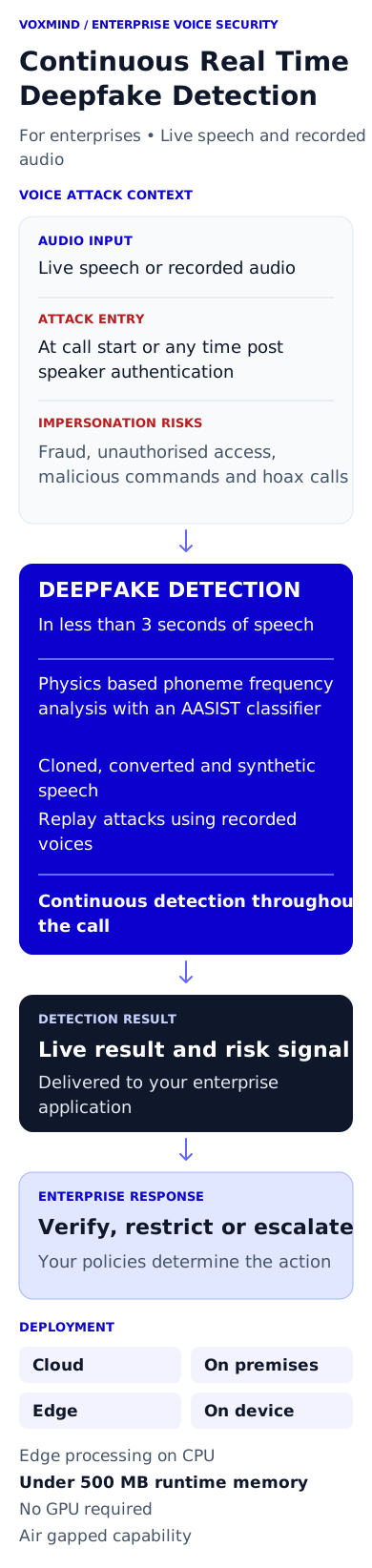
Voxmind exposes cloned, converted and synthetic voices during live interactions, screens for replayed recordings and monitors authenticity throughout the conversation. Combine detection with speaker authentication to verify who is speaking and assess the audio behind the request.
Deploy in the cloud, at the edge or within air-gapped infrastructure. Process audio through an API, on private servers or locally on compatible devices.
Why physics-based analysis matters for voice security
A convincing voice clone can reproduce a person’s tone, cadence and speaking style. Enterprise security needs to assess the authenticity of that speech alongside the claimed identity.
Voxmind’s proprietary phoneme-frequency analysis fused with an AASIST-based spectro-temporal classifier examines acoustic characteristics associated with speech production and the human vocal tract. This physics-based analysis forms part of a platform that combines speaker verification with checks for synthetic, converted and replayed audio.
The distinction is fundamental. A voice identity match establishes similarity to an enrolled speaker. Audio authenticity checks assess whether the speech shows evidence of manipulation. Voxmind brings both assessments into the same interaction.
Standalone detection can screen callers whose identity has yet to be established. Enrolled-speaker authentication adds verification against a known person’s voice template. Enterprises can integrate detection alongside existing biometrics or adopt the combined capabilities.
Human vs AI voice detection
Deepfake Detection Without Voice Enrolment
Voxmind detects synthetic and cloned speech without an enrolled voiceprint or a reference sample from the claimed speaker. It analyses vocal tract physics and phoneme frequency characteristics to assess voice authenticity in live audio streams and recordings. Detection runs on edge devices, on premises or in the cloud.
This enables enterprises to screen first contact calls and examine recordings submitted for investigation. Where an enrolled voiceprint is available, Voxmind also performs biometric speaker verification, providing identity and voice authenticity signals for authentication and fraud assessment.
Anti-spoofing performance measured on ASVspoof datasets
Voxmind reports the following results on the ASVspoof 2021 evaluation datasets:
Equal error rate measured by Voxmind on the public ASVspoof 2021 evaluation sets: 0.78% (Logical Access) and 2.65% (Speech Deepfake). Detection combines Voxmind’s proprietary phoneme-frequency analysis with AASIST, a peer-reviewed anti-spoofing architecture. Independent verification of Voxmind’s results is in progress.
Equal error rate is the threshold at which genuine-speech rejection and spoof acceptance rates are equal. Lower values indicate better performance under the specified test conditions.
These company-reported results provide a benchmark reference for technical assessment. A deployment evaluation measures detection and false positives at the operating threshold selected for your calls, devices and attack scenarios.
Continuous detection through the moment of approval
The most consequential request can arrive several minutes into a call. An opening identity check captures one moment; the conversation can subsequently change.
Voxmind continues assessing voice identity and authenticity as the interaction develops. This supports detection of speaker changes, converted speech and synthetic audio introduced after initial verification, including post-authentication call takeover.
Your application receives signals that can trigger further verification, alert an agent or hold a sensitive action for review. Approval remains governed by your organisation’s permissions and transaction policies.
| Voice attack | What the system assesses |
|---|---|
| AI voice cloning | Indications of generated speech imitating a real person |
| Live voice conversion | Characteristics of speech transformed during an interactive conversation |
| Recorded replay | Signs that captured speech is being reused |
| Synthetic audio injection | Authenticity of the audio received from the call or application |
| Post-authentication takeover | Changes in speaker identity or audio authenticity during the session |
Edge deepfake detection for air-gapped environments
Security requirements often determine where voice processing must run. Restricted networks, remote facilities and embedded devices need local assessment within their own infrastructure boundary.
Voxmind supports on-device and edge processing on compatible hardware, including deployment within air-gapped environments. Inference runs locally, allowing audio assessment during operation independently of external cloud connectivity.
This makes the deployment model relevant to secure communications, critical infrastructure, industrial sites and OEM products where audio access, data movement and network segmentation are tightly controlled.
| Deployment | Processing location | Enterprise application |
|---|---|---|
| Cloud API | Hosted service accessed by the application | Centralised customer service and enterprise applications |
| Private infrastructure | Customer-controlled servers | Regulated voice workflows and restricted hosting requirements |
| Edge | Local gateway or site infrastructure | Operational communications and segmented networks |
| On-device | Compatible endpoint hardware | Embedded communications products and operator devices |
Air-gapped operation is established through the complete deployment design, including installation, licensing, model updates, logging and support procedures. These requirements are agreed during technical evaluation.
Voxmind’s embedded optimisation programme runs in under 500mb runtime memory, CPU-only, on embedded hardware. Hardware requirements are assessed against the selected processor and audio workload.
Protect payments, access and operational instructions
Payment approvals and beneficiary changes
A caller completes the initial checks, then requests a transfer to a new beneficiary. Voxmind screens the voice during the instruction while the bank evaluates the account, device and transaction context.
A flagged result can initiate an independent callback or additional verification before the payment proceeds.
Account recovery and privileged credential resets
An impersonator contacts a service desk with enough account knowledge to make a reset request credible. Standalone detection adds an assessment of the speech while the service desk establishes identity through its recovery process.
Where an enrolled template is available, speaker authentication supplies an additional identity signal.
Operator communications and remote approvals
An instruction arrives through an intercom, communications endpoint or operator console. Voxmind can screen the speech and verify an enrolled approver locally.
The customer application checks the approver’s permissions and links the assessment to the specific request, supporting an auditable process for maintenance, access and operational changes.
Integrate with your existing voice infrastructure
Voxmind receives audio through supported APIs, streaming interfaces or embedded SDKs. Integration starts with the point where your platform exposes the audio and the decision that needs protection.
The engine returns detection results and the identity or session signals enabled for the deployment. Your application presents those results to agents, security teams or automated decision systems.
The technical review establishes audio compatibility, processing latency, decision thresholds and behaviour when results are inconclusive or the service is unavailable.
Local processing can keep raw audio within your environment. Retention, access and deletion controls are defined for audio, enrolled templates and session records.
Evaluate detection on your calls and hardware
Bring a defined workflow and representative audio. Agree acceptance criteria covering:
- Detection: cloned, converted and replayed speech relevant to the application.
- False positives: genuine callers across the languages, accents, noise and codecs your service encounters.
- Responsiveness: audio duration and processing time required for an actionable result.
- Deployment: memory, throughput and operation on the intended cloud, edge or on-device configuration.
- Response: escalation, independent verification and the records required for investigation.
Start with a demonstration then scope an evaluation and pilot around the decision you need to protect.