
MFA-Compliant Voice Authentication for Enterprise Security
Voxmind adds real human voice verification to high-risk enterprise authentication workflows.
Cloned speech, replayed audio, live voice conversion and synthetic voice injection now expose the limits of security questions, static speaker matching and fragmented identity checks. Voxmind provides a real time voice authentication layer that verifies speaker identity, confirms human presence, detects deepfake voice fraud and monitors risk throughout the interaction.
Enterprise authentication has a voice security gap
AI voice cloning has changed the assurance model for voice-based authentication. Synthetic speech now creates credible voice interactions that sound familiar, move through trusted support workflows and challenge controls built for an earlier threat environment.
Voxmind addresses this gap with an MFA-compliant voice authentication layer for high risk voice interactions. The platform verifies whether the speaker matches the enrolled identity, whether the voice is live and human, and whether the interaction remains trustworthy as risk changes.
This gives security, fraud and customer operations teams a stronger authentication signal at the point where spoken interaction creates operational risk.
Where Voxmind sits in MFA compliant authentication architecture
Voxmind operates as a real time voice inherence factor within enterprise authentication flows, adding speaker verification, human presence analysis and voice authenticity detection at the point where a spoken interaction becomes security relevant.
The platform sits between the voice channel and the enterprise decision layer. Audio from a contact centre, voice AI platform, UCaaS environment, telecom workflow or embedded system is assessed against the enrolled voice identity and live authenticity signals. Voxmind then returns identity confidence, deepfake indicators, replay risk, human authenticity signals and session risk outputs that support the enterprise policy decision.
This allows voice to become an active authentication signal inside MFA-compliant workflows, alongside device trust, account context, secure app sessions, one time passcodes, PINs, risk engines and identity orchestration tools. The value is strongest where a sensitive action is requested by voice including account recovery, payment approval, credential reset, identity change, fraud escalation and privileged support workflows.
Voxmind strengthens the voice factor by combining identity matching with liveness, synthetic speech detection and continuous monitoring after the first verification event. The result is a voice authentication control that supports step up verification, workflow escalation, fraud review and policy-based interruption when the interaction no longer meets the required assurance threshold.
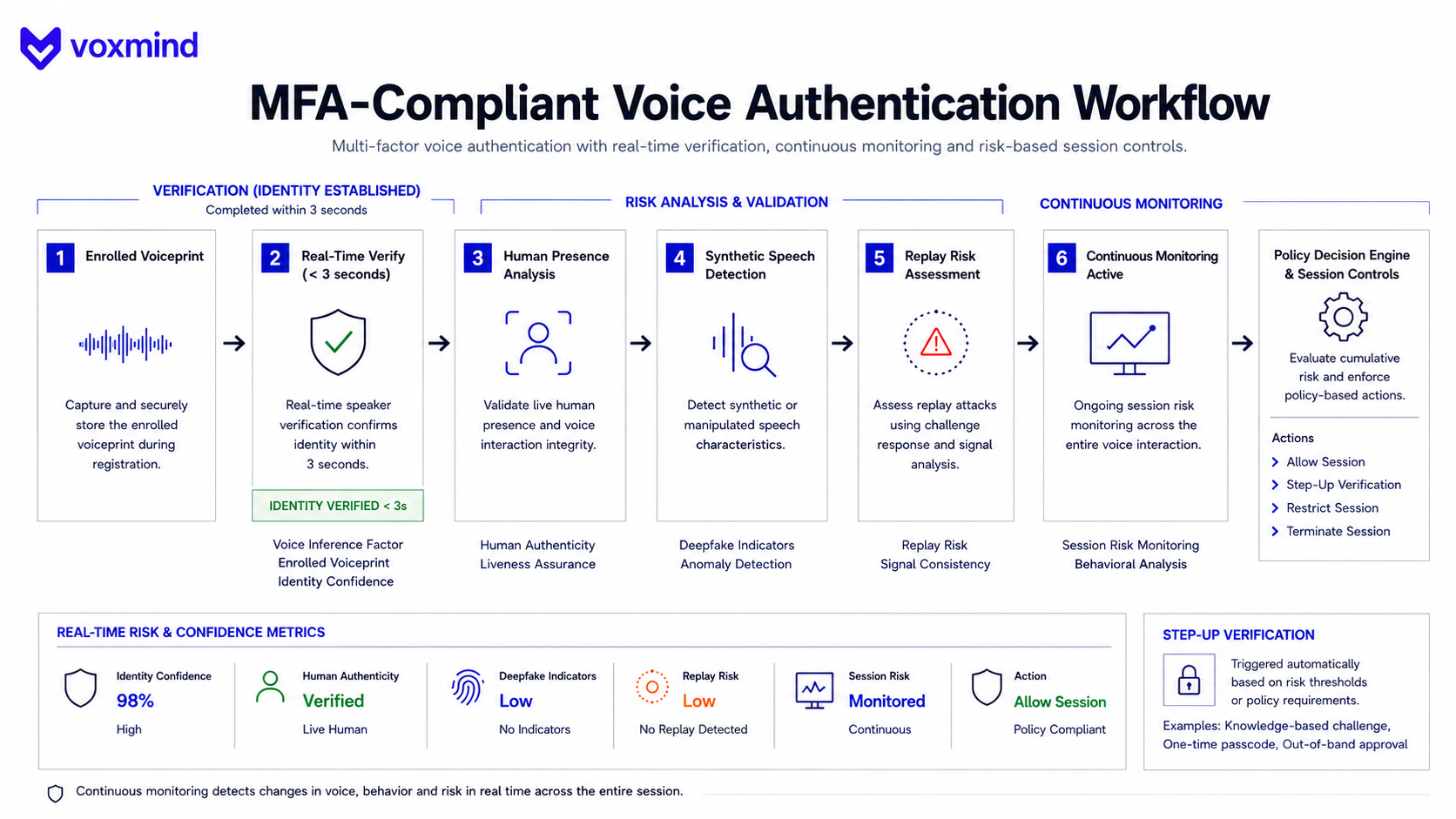 View full-size diagram
Continuous monitoring after verification
Initial verification gives a point in time result. Voice fraud develops across the session.
Post authentication call takeover occurs when an interaction appears legitimate after verification, then becomes compromised during a later stage of the call. Social engineering, replayed audio, live voice conversion and synthetic voice manipulation increase the risk that a trusted session moves toward a high value action under false assurance.
Voxmind monitors identity confidence, human authenticity and fraud signals throughout the interaction. This supports detection of call takeover, voice session hijacking, cloned speech, replay attacks and live synthetic voice manipulation while the session is active.
Deepfake detection inside authentication workflows
MFA workflows require a voice factor that distinguishes real human speech from synthetic or manipulated audio. Voxmind detects cloned voices, replayed samples, live voice conversion and synthetic voice injection during enterprise voice interactions.
These signals support access decisions, step up verification, fraud review, escalation and workflow interruption according to the enterprise security policy. The authentication workflow gains a live fraud detection layer rather than relying on static speaker matching or manual challenge questions.
Enterprise use cases
Contact centres
Voxmind helps contact centres reduce reliance on manual security questions while strengthening protection around account recovery, payment approval, credential reset and sensitive support workflows. Genuine customers move through verification faster while higher risk sessions receive targeted scrutiny.
Banking and financial services
Voxmind supports regulated financial interactions where voice-based decisions carry fraud, compliance and customer trust implications. Typical workflows include account access, wealth management instructions, payment approvals, fraud operations and high value account changes.
Telecoms
Voxmind supports voice security for customer service, carrier workflows, account changes, SIM related support and service provider environments. Telecom teams gain identity and authenticity monitoring across interactions exposed to social engineering and account takeover attempts.
Voice AI platforms
Voxmind adds real human verification to AI agents, IVR systems, CCaaS platforms, UCaaS environments and automated voice workflows. This helps platforms verify whether voice input comes from an authorised human rather than cloned, replayed or synthetic speech.
Enterprise benefits
Voxmind strengthens identity assurance by verifying the speaker, human presence and voice authenticity in the same interaction. Security teams gain a richer view of voice risk than static speaker matching or knowledge-based checks provide.
The platform reduces authentication friction by shortening the path for genuine users. Voice verification happens in real time, while higher risk sessions receive targeted escalation based on live fraud signals.
Voxmind improves fraud visibility across the interaction. Security and fraud teams receive identity confidence, deepfake indicators, replay risk, human authenticity and post authentication takeover signals as the session develops.
For customer operations teams, the result is faster authentication with stronger fraud controls. For security teams, the result is a live voice security layer that supports access decisions, escalation and investigation.
Security, privacy and data controls
Voxmind gives enterprises control over raw audio, voiceprints, authentication telemetry, retention, deletion, encryption and data residency. Its data protocols are designed to support regulated biometric voice workflows, including EU GDPR and UK GDPR requirements.
Enterprise adoption depends on detection performance, accountable data handling and integration into existing security architecture. Voxmind is built for environments where authentication, fraud prevention, privacy, compliance and operational control must work together.
Built for enterprise integration
Voxmind integrates through APIs, streaming protocols, SIP and embedded SDKs, depending on where audio is captured and where the authentication decision is made.
The platform supports contact centre systems, voice AI platforms, telecom infrastructure, financial services workflows, edge devices and enterprise identity architectures. Voxmind fits into existing operational and security environments without forcing teams to rebuild the voice workflow around a single deployment model.
FAQs
What is MFA-compliant voice authentication?
MFA compliant voice authentication uses voice as an inherence factor inside a broader multi factor authentication workflow. Voxmind supports this by verifying speaker identity, human presence and voice authenticity in real time.
Where does Voxmind sit in the MFA architecture?
Voxmind sits at the point where the spoken interaction creates risk. It adds a real time voice factor to workflows that may already include registered devices, secure app sessions, one-time passcodes, PINs, identity orchestration tools or contact centre verification processes.
How does Voxmind strengthen the voice factor?
Voxmind verifies the enrolled speaker, confirms that the voice is live and human, detects synthetic or manipulated speech and monitors risk across the session.
How does continuous monitoring improve authentication?
Continuous monitoring assesses identity confidence, human authenticity and fraud signals after the first verification event. This helps enterprises detect post authentication call takeover, voice session hijacking and changing voice risk during the interaction.
What data controls does Voxmind support?
Voxmind gives enterprises control over raw audio, voiceprints, authentication telemetry, retention, deletion, encryption and data residency. Its data protocols are designed to support regulated biometric voice workflows, including EU GDPR and UK GDPR requirements.