Biometric Data Protection
Control where biometric voice data is processed, stored, encrypted and deleted.
Voxmind gives enterprises control over data residency, deployment model, encryption, retention and access for biometric voice verification. Raw audio is processed in memory and discarded by default. Voiceprints are stored as irreversible feature representations, not playable audio, with deployment options that support regional cloud, customer-managed cloud, and on-premise operation.
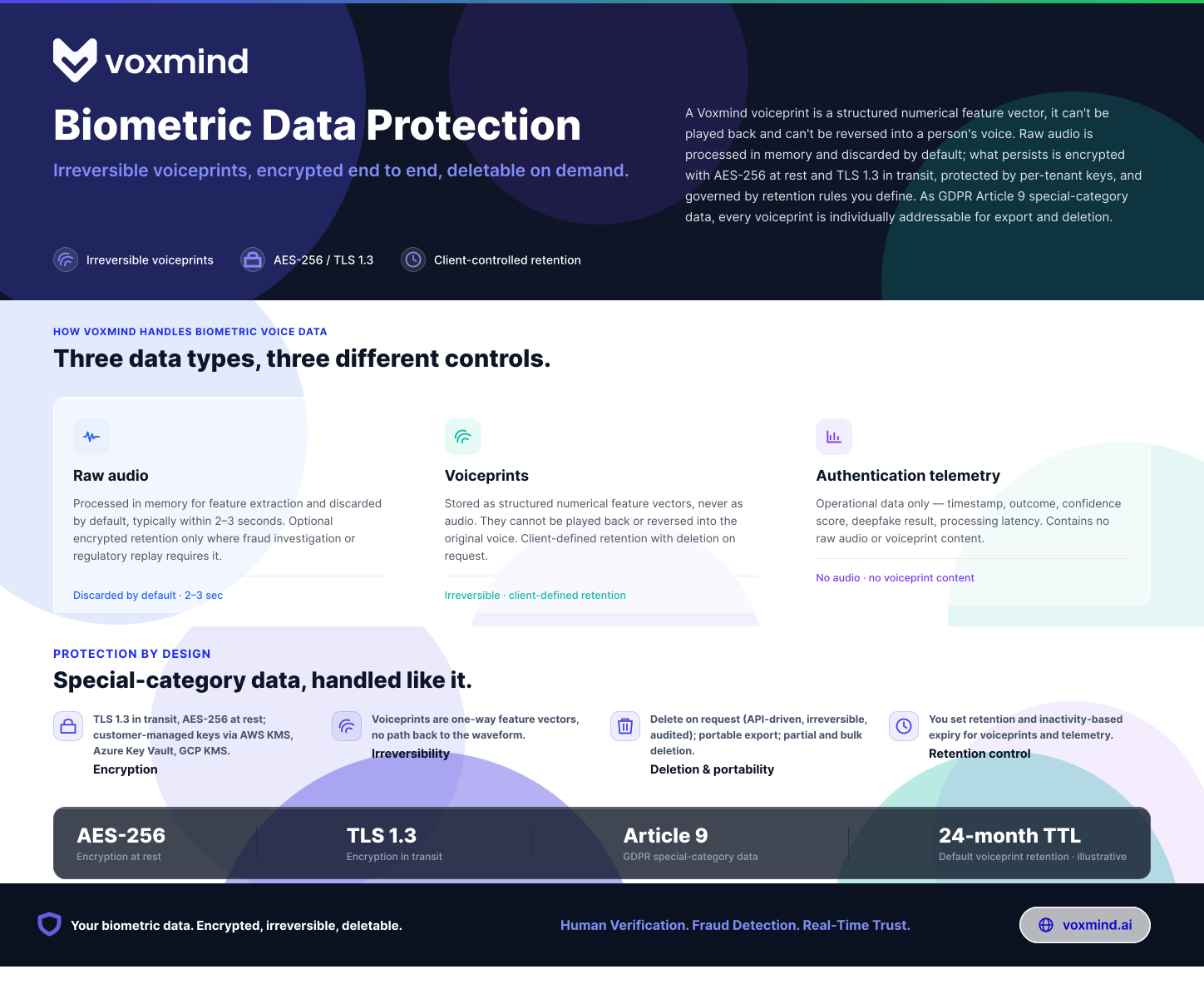
Three data types, three different controls.
Voxmind handles raw audio, persistent voiceprints and authentication telemetry differently. Raw audio is transient by default. Voiceprints are persistent biometric data protected with encryption and client-defined retention. Authentication telemetry is stored separately for monitoring, analytics and reporting.
Raw audio
Processed in memory for feature extraction and discarded by default, typically within 2 to 3 seconds. Optional encrypted retention can be configured where a client requires fraud investigation or regulatory replay.
Voiceprints
Stored as structured numerical feature vectors, not audio. They cannot be played back and cannot be used to reconstruct the original voice. Retention is client-defined with deletion on request and automatic expiry options.
Authentication telemetry
Stored as structured operational data such as timestamp, authentication outcome, confidence score, deepfake result and processing latency. It does not contain raw audio or voiceprint content.
Regional cloud, customer-managed cloud or on-premise deployment.
Voxmind supports three deployment models, each designed for different residency, control and integration requirements. Enterprises can choose the operating model that fits their regulatory environment and infrastructure standards.
Regional cloud deployment
Processing and storage run in a regional Voxmind-managed environment. UK, EU, and US regional zones are available. Cross-region replication is opt-in only and disabled by default. Regional residency is enforced at the processing and storage layers.
Customer-managed cloud
The Voxmind engine runs inside the client's own AWS, Azure or Google Cloud account. The client retains control of network boundaries, storage, encryption keys and identity controls while Voxmind provides the engine and operational support.
On-premise deployment
For organisations that do not place biometric data in cloud environments, Voxmind can be deployed entirely within client-operated data centres. On-premise deployment is available and scoped per engagement.
Irreversible voiceprints, strong encryption and client-controlled retention.
Voiceprints are biometric special category data under GDPR Article 9 and equivalent data protection regimes. Voxmind is designed to handle them accordingly with AES-256 encryption at rest, TLS 1.3 in transit, per-tenant encryption keys and support for customer-managed keys. Voiceprints are individually addressable for deletion, export and lifecycle control.
Encryption
TLS 1.3 in transit, AES-256 at rest, with support for customer-managed keys through AWS KMS, Azure Key Vault and Google Cloud KMS.
Deletion and portability
Voiceprints can be deleted on request and exported in portable format where required for data subject rights handling. Partial deletion and bulk deletion are both supported.
Retention control
Clients define retention policies for voiceprints and authentication telemetry including inactivity-based expiry.
Support for Article 9 biometric data handling, data subject rights and DPIA preparation.
Voxmind's architecture supports explicit consent or other lawful bases where permitted by the deployment context, deletion on request, portable export, cross-border transfer controls and template DPIA content for client adaptation. Voxmind also provides NDA-based diligence materials for procurement, InfoSec and cloud security review.
GDPR handling
Supports GDPR Article 9 biometric data processing requirements, data subject rights workflows, regionally bounded deployment and deletion on request.
Cross-border transfer control
Default deployment is regionally bounded. Where cross-border transfer is required, Standard Contractual Clauses or equivalent mechanisms are supported.
DPIA support
Template DPIA content is available covering the technology, processing operations and risk mitigations.
The visibility, assurance and oversight security teams expect
Voxmind combines least-privilege access control, mandatory MFA for administrative users, SSO integration, immutable audit trails, SIEM integration, operational alerting, vulnerability scanning, patch management, third-party penetration testing, and formal incident response procedures.
Access control
Role-based access control, least-privilege defaults, SSO integration, and MFA for all administrative access.
Audit and monitoring
Authentication events, configuration changes, and administrative actions are logged and can be integrated into client SIEM platforms such as Splunk, Sentinel, and QRadar.
Security testing
Regular third-party penetration testing, continuous dependency scanning, coordinated disclosure, and incident response procedures aligned with recognised standards.
Voxmind gives enterprises control over where biometric voice data is processed, how it is protected and when it is deleted.
The architecture supports configurable processing location, zero-retention raw audio by default, irreversible voiceprints, customer-managed cloud deployment, on-premise deployment, optional encrypted audio retention where required, and deletion workflows aligned to client policy.
See Voxmind in Action
Review how Voxmind handles raw audio, voiceprints, regional deployment, and biometric data protection across cloud-managed, customer-managed and on-premise environments.
Voice data sovereignty and biometric data protection
Where is voice data processed and stored?
Voxmind supports regional cloud-managed deployment, customer-managed cloud deployment, and on-premise deployment. Processing and storage location are configurable by deployment model and residency requirement.
Is raw audio retained?
By default, no. Raw audio is processed in memory for feature extraction and discarded. Optional encrypted retention can be configured when a client requires regulatory replay or fraud investigation storage.
Can voiceprints be converted back into audio?
No. Voiceprints are stored as structured feature vectors and cannot be used to reconstruct the original audio.
Can Voxmind run in our own cloud account?
Yes. Voxmind supports customer-managed cloud deployment in AWS, Azure, and Google Cloud.
Is on-premise deployment available?
Yes. On-premise deployment is available and scoped per engagement.
How are voiceprints protected?
Voiceprints are encrypted with AES-256 at rest, protected with TLS 1.3 in transit, and can use customer-managed keys.
Can voiceprints be deleted on request?
Yes. Voiceprints are individually addressable and can be deleted on request, with audited deletion workflows and configurable retention policies.