Upgrade from centralized cloud voice matching to real-time human verification
Cloud-based voice biometrics send voice data to remote infrastructure, compare it with stored profiles and return a decision after processing. That model is increasingly ineffective when fraud is occurring during the interaction.
Voxmind enables enterprises to verify human presence, detect synthetic and replayed audio in real time and run voice verification closer to the interaction.
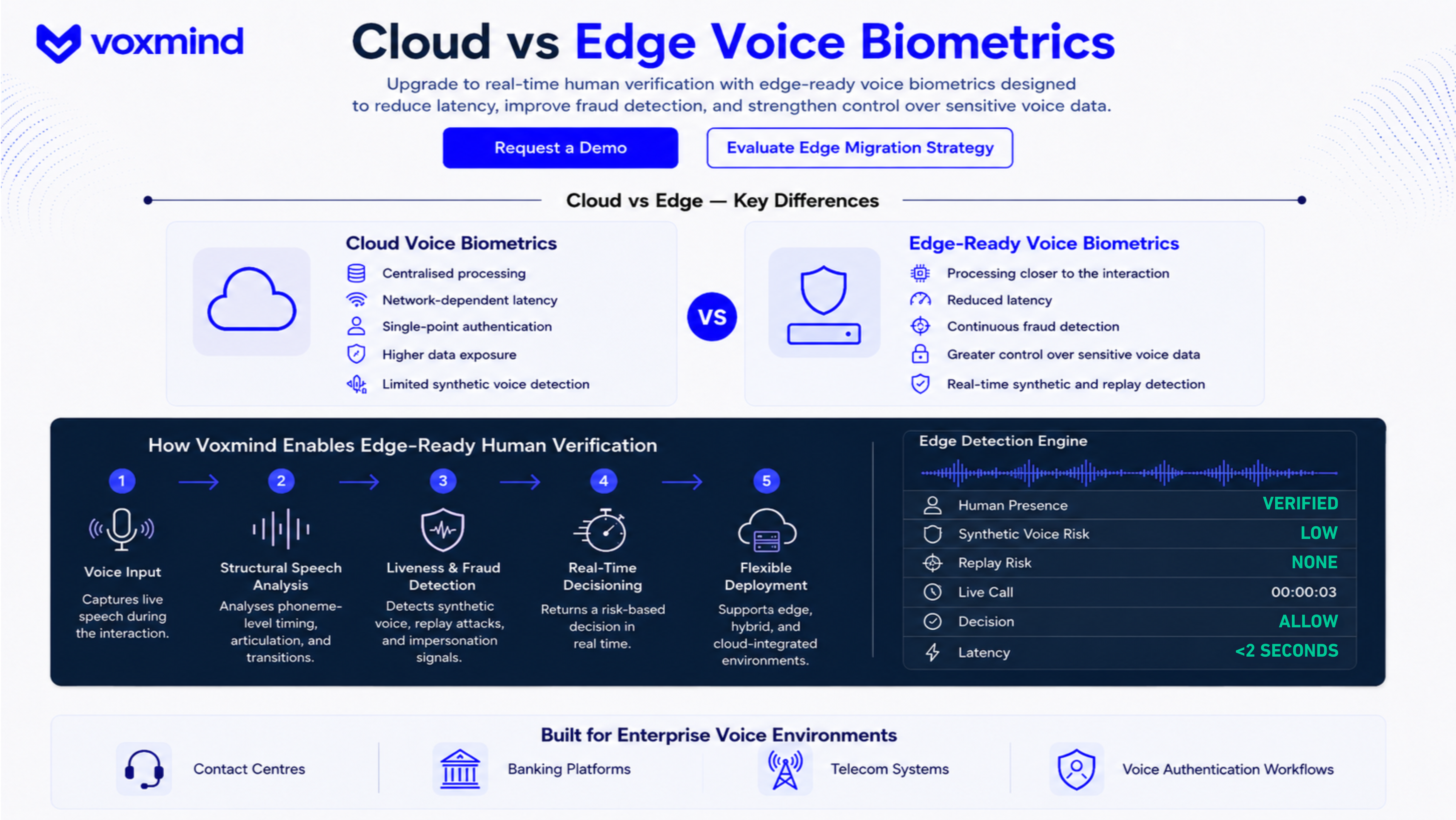
Centralized cloud voice matching slows decisions, widens data exposure and increasingly fails to detect fraud during live interactions.
Traditional voice biometrics platforms rely on centralized processing. Voice data is sent to remote data centres, matched against stored profiles and returned as a decision.
The model creates four problems when the interaction itself has become the attack surface.
- 01Network travel adds latency to each decision.
- 02Processing depends on centralized cloud infrastructure.
- 03Fraud detection is weaker when analysis happens after transmission and matching.
- 04Sensitive voice data is exposed to wider transfer and handling.
Edge-ready human verification changes where decisions are made, how quickly fraud is detected and the control enterprises retain over voice data.
Edge-ready voice verification processes audio nearer to the point of use. That shortens decision time, limits unnecessary transfer and improves control over sensitive voice data.
Latency and performance
Processes nearer to the interaction to shorten response time during live calls.
Data handling and security
Processes locally or regionally and transfers only the data needed for orchestration.
Fraud detection capability
Detects synthetic voice, deepfake audio and replay attacks during the interaction.
Real-time human verification for live voice environments
Voxmind replaces centralized cloud voice matching with real-time human verification designed for live interactions.
Structural speech analysis
Analyse how speech is produced rather than relying only on acoustic similarity.
Real-time liveness detection
Verify that the speaker is human and live during the interaction.
Synthetic voice and replay detection
Detect AI-generated speech and replayed audio in real time.
Continuous interaction monitoring
Analyse the interaction from start to finish; not just at one authentication step.
Migration triggers for enterprise voice systems
Enterprises typically move from cloud-only voice biometrics when operational requirements change faster than the architecture can support.
Increasing voice fraud
Response to impersonation, synthetic voices and replay attacks during live interactions.
Latency constraints
Response to delays where cloud processing creates friction in customer service or authentication workflows.
Synthetic voice attacks
Legacy systems' inability to reliably detect manipulated audio.
Real-time decision-making
Increasing imperative for decisions in support environments to be made during the call and not later.
Voxmind's edge-ready verification advantage
Voxmind processes voice data during the interaction rather than waiting for delayed cloud-side analysis. This enables immediate decisions and early fraud detection.
The platform supports a hybrid operation, combining edge-based verification with cloud orchestration where scale, management and coordination are required.
Processing during live interactions
Applies computation while the interaction is happening.
Reduced latency
Avoids sending full decision flows to remote data centres for each verification step.
Hybrid architecture
Combines edge-based verification with cloud orchestration and scale.
Continuous detection
Operates across pre-authentication, live interaction and post-authentication phases.
Key differences in voice verification architecture
Cloud-based systems were built for voice matching. Edge-ready systems are built for real-time human verification and fraud detection.
Real-time human verification with low latency and strong fraud detection
Cloud-based systems match a voice after centralized processing. Edge-ready human verification determines whether the voice is human, live and trustworthy during the interaction.
See Voxmind in Action
Watch Voxmind verify human presence, detect fraud in real time and operate across cloud, edge, on-device and hybrid environments.
Cloud vs edge voice biometrics
What is the difference between cloud and edge voice biometrics?
Cloud voice biometrics relies on centralized processing and remote matching. Edge-ready systems process closer to the interaction, which shortens response time and improves control over data handling.
Why does edge-ready architecture reduce latency?
It reduces network travel by processing closer to the source of the interaction.
What is a hybrid approach to voice authentication?
A hybrid approach combines edge-based verification with cloud orchestration and scale.
How does this improve fraud detection?
It enables detection of synthetic voice, replay attacks, and manipulated audio during the interaction rather than after centralized processing.
Does Voxmind require sending all voice data to the cloud?
No. Voxmind can limit transfer and send only the data needed for orchestration and system management.
Can Voxmind be deployed alongside cloud services?
Yes. Voxmind supports cloud-connected and hybrid environments while moving verification closer to the interaction.